Transmission Kit · Chapter 16
Carry this chapter
Everything needed to file this chapter somewhere else. The copy below is the chapter’s own promotional language — hook, caption and tags in one block, nothing to assemble.
The artifact for this final chapter is a registration filing: The Justice Society of Activism, headquartered in Glendale, Arizona. I built it because the existing channels — HR, ethics complaints, the formal process you are instructed to trust — had already demonstrated, repeatedly, that they were designed to protect the institution more than the person inside it. Legal channels were real and I was using them, but they are slow and technical and address only the violation code, not the daily experience of being treated as though your record is not real.
I documented nine incidents through the proper ethics channel. What followed was not investigation but intercept — a process that moved laterally instead of forward, producing a Formal Written Warning I did not agree with. I escalated. I hired a lawyer. I filed with the EEOC. I documented network disruptions across 97 days, 2,443 events across two monitored shifts, four system crashes, seven authentication failures, a pattern that did not look like coincidence. I am entering this chapter as testimony specifically because it is unresolved — a deposition filed mid-case, not after a verdict, because the record needs to exist whether or not I am the one who gets to narrate its ending.
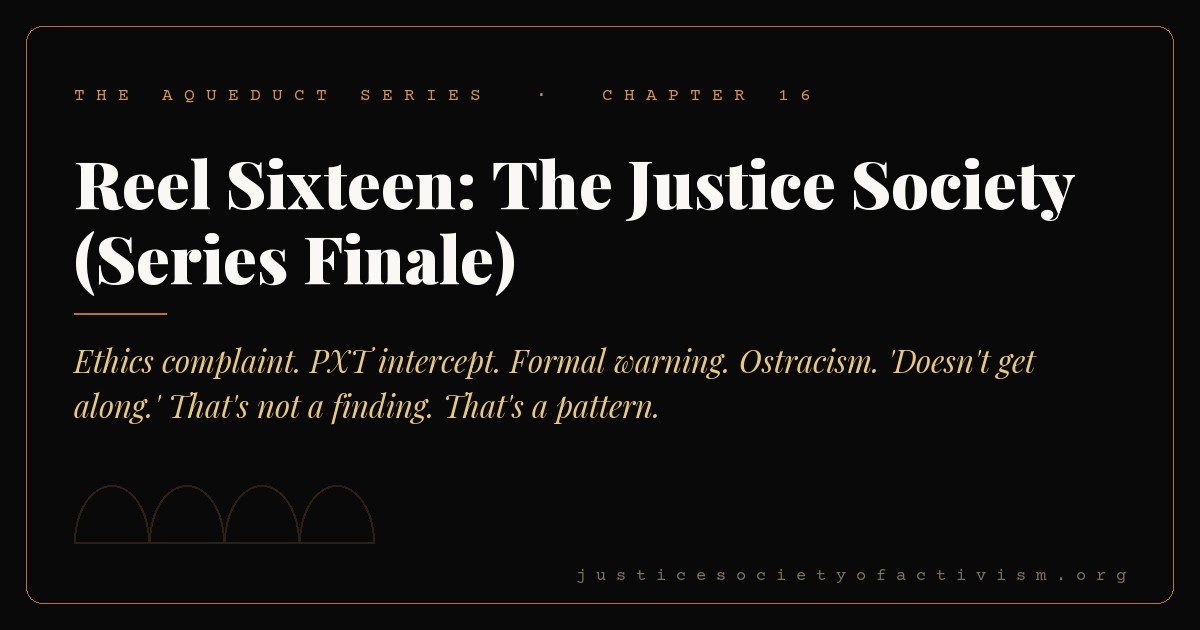
The chain the report identified was this: ethics complaint → PXT intercept → formal warning → ostracism → "doesn't get along." That is not a finding. That is a pattern. And patterns can be documented.
Every chapter before this one in the series has been witness testimony — here is what happened, here is what it cost, here is what it made of me. This chapter is different. It is the first artifact in the record built on purpose, after the fact, to construct new infrastructure for whoever crosses this same gap next, instead of only documenting what the gap took from me. The Justice Society exists at the exact seam this whole series has been describing — the space between who has access to justice and who absorbs the cost of not having it.
I am writing the final chapter of this series from the most exposed position in it: fluent in exactly what systemic failure costs a person who has to document it alone, native to neither a clean resolution nor a guarantee that documenting it changes anything. I grew up in Philadelphia watching people absorb conditions they should not have had to absorb because the cost of fighting was higher than they could afford. I thought, from a very young age, that this was simply wrong. The Justice Society is my attempt to do something about that gap, small and new and working with limited resources, with my name on it and an EIN behind it.
I do not have a triumphant ending for this chapter, or for this series. The case is active. The organization is early-stage. My kidneys are being monitored. My daughter is ten. The house is mine. The adversity was not the ending, which is why I kept building — but I want to be honest about what "kept building" actually means here: it means the record stays open, the case stays unresolved, and I do not get to tell you, as the last line of this series, that it all worked out. I only get to tell you that I am still here, still filing testimony, still waiting to find out which parts of this hold.
Everything needed to file this chapter somewhere else. The copy below is the chapter’s own promotional language — hook, caption and tags in one block, nothing to assemble.